Welcome to OM. This is a customizable intro section and you can definitely choose the Social Network icons that you will use. Thanks for checking out OM!

How to Baby Proof Your Fireplace
BY mariouda2108
0 COMMENTS
0 COMMENTS
How to Baby Proof Your Fireplace
If you belong to the over thirty percent of Americans who use a fireplace to heat your home, and if you have or are soon going to welcome a young child into your home, then you definitely need to baby-proof your fireplace! As lovely as the warm heat of the fireplace is, it is a clear hazard for a curious child, just starting to crawl or walk and attracted by the dancing, flickering lights within.
But don’t worry – you do not have to choose between your fireplace and your child! Read on to learn about several ways to childproof your fireplace.
Methods for Childproofing Your Fireplace
Whether you’re trying to keep your child safe from burns, bumps, or carbon monoxide poisoning, there are several important hazards to consider when you childproof your fireplace, and different solutions to protect your child from each of them. Here are some methods for you to consider applying as you childproof your fireplace!
Use a Baby Gate
No matter what kind of fireplace you have, the simplest and most direct way to keep your child safe from a burn is to keep them away from the fireplace altogether. You can achieve this with a baby gate, just like how you might fence off the top of a flight of stairs! This can mean creating a fenced off play area in the room for your child, surrounded by the baby gate. Alternatively, you can fence off the fireplace itself from the rest of the room, using a fireplace screen.
Play Area
The “play area” option allows you to keep your curious child contained while allowing them to have fun with whatever toys and games you supply them with. It’s much easier to keep an eye on your little one when you know exactly where they will be! This method does mean that the fireplace itself will still be exposed, so if your child learns how to climb out of the play area, as they all eventually do, you may want to consider fencing off the fireplace itself to avoid burns.
Fireplace Screen
If you choose to use a fireplace screen, avoid using a free standing screen – a baby just learning to walk can very easily pull down the screen, potentially falling into the fireplace! The screen should be sturdy, and firmly secured to the walls on either side of the fireplace. This method allows your child to have free range of the room without being able to come into contact with the fire. Fireplace screens do often come with a gate that will allow you to access the fireplace itself to start a new fire or add wood to an already burning one. Just be sure that your child is out of the way when you open the gate!
Decorate the Hearth
Another option is to simply not use the fireplace once you have a baby crawling around. If there is no fire, then there cannot be burns! But this does not mean that the fireplace no longer serves a purpose! The hearth can become the backdrop for a play kitchen or other sets of toys for your child. You can also decorate it in a multitude of ways, placing photos on the upper mantle or adding a cover. Some parents transform their fireplaces into a chalkboard or magnet board, perfect for creative fun!
Corner Guards
The fire itself is not the only hazard to your child to be found in a fireplace. If your fireplace has a stepped hearth, it may have sharp or rough edges which could potentially hurt your toddler as they start to figure out how to walk. To avoid these accidents, you can protect both your child and your fireplace with corner guards. These can be purchased online or crafted at home. In either case, be sure to use flame-retardant materials if you intend to continue to burn wood or gas in fireplace.
Fireplace Door Lock
Even when the fire is off, you definitely do not want your child getting into the fireplace. They will come out again looking like a chimney sweep, tracking soot around the house! A curious child may also end up pinching their fingers in the fireplace door as they try to figure out what is inside, just like they might try to get into your refrigerator, cabinets, or bathroom. A fireplace door lock is the answer here. You mount this lock over the handles of the doors of your fireplace, using a screwdriver.
Carbon Monoxide Detector
Whether you are burning wood, gas, or coal in your fireplace, the resulting fire releases carbon monoxide. Inhaling too much carbon monoxide can cause carbon monoxide poisoning, with symptoms such as nausea, headaches, confusion, drowsiness, chest pain, and complete loss of consciousness. This might not seem like an issue related to childproofing your fireplace, but children are even more susceptible to carbon monoxide poisoning than adults, because their bodies are smaller. If the vents or exhausts of your fireplace are not regularly and properly cleaned, then carbon monoxide levels in your house can reach harmful levels for you and your family. Worst of all, carbon monoxide can neither be seen, tasted, nor smelled – so you must be proactive to protect your child from this invisible side effect of your fireplace!
Naturally, the best way to avoid carbon monoxide poisoning is to not burn a fire at all. However, if you do have and use your fireplace, keeping your fireplace vents and exhausts clean and working well is essential. But even with the best and cleanest vents, carbon monoxide levels can rise. To keep track of these levels, you should invest in a carbon monoxide detector. One detector on every floor of your home is ideal. These detectors are plugged into an electrical socket and will sound a loud alarm if it detects an elevated carbon monoxide level, alerting you to evacuate and keep both you and your family safe.
Now you’re ready to create a safe home for your baby and yourself by childproofing your fireplace!

How to Baby Proof Your Stairs – Child Proofing Ideas
BY mariouda2108
0 COMMENTS
0 COMMENTS
How to Baby Proof Your Stairs – Child Proofing Ideas
If your house has multiple floors, and you have or are expecting to welcome a new child into your home, you definitely want to consider childproofing your stairs. Soon enough, your baby will start crawling and toddling, eagerly setting about exploring their surroundings – and the last thing you want is for them to get hurt tumbling down a flight of stairs!
To learn some steps to make sure your stairs are baby-proof and safe, read on!
Methods for Childproofing Your Stairs
If your child is not yet a competent walker, then there really is no way to safely allow them to go up or down without your help – so you want to be sure to secure both the top and the bottom of the staircase. Here are some methods and other factors to consider for childproofing your stairs!
Set Up Baby Gates
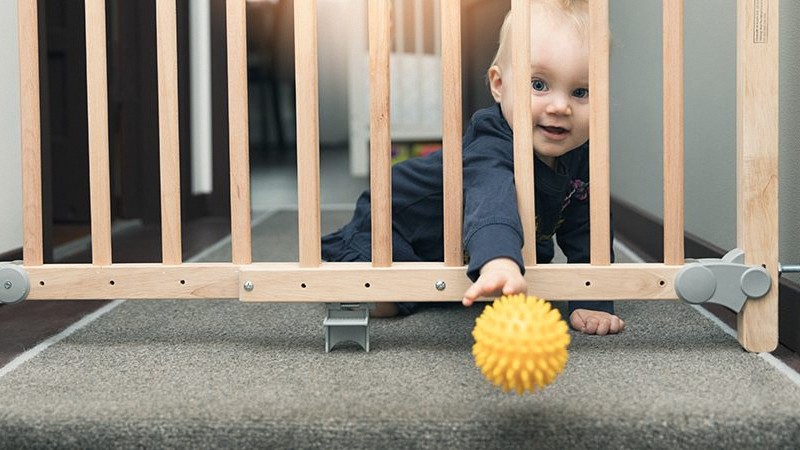
The simplest and most obvious way to keep your baby away from the top or bottom of a staircase is to set up a baby gate. Make sure you get a baby gate that completely blocks access to the stairs – all toddlers are excellent escape artists!
While setting up your baby gate, make sure you read the instructions thoroughly. It is essential that the baby gate be stable and secure; an early walker can easily pull down an unstable baby gate. This is particularly necessary for the gate at the top of the stairs because at least your baby will not be falling far if they get at the bottom of the stairs. You may have to drill into the banister or wall near the staircase in order to securely mount the gate. You also don’t want the baby gate to fall over onto your baby. Accordion baby gates are particularly hazardous if they fall over under a child’s weight, as they can trap and pinch your baby underneath them.
When walking through a baby gate, be sure to completely close it behind you, even though this takes more time than just allowing it to swing shut. If you leave the gate open by mistake, that defeats the purpose of putting it up in the first place!
Of course, once your baby begins to learn how to climb, it will be time to get rid of the baby gates, lest they seem a tempting yet hazardous climbing wall. At that point, it will be time to teach your older toddler how to use the stairs!
Keep Your Stairs Well-Maintained
Like any piece of furniture, stairs can grow worn with repeated use. Every time you set foot on a stair or grab a banister, you add a little bit of wear and tear to the staircase. A set of stairs with exposed nails, loose steps, or rough edges can be both hazardous for your child and for yourself – you do not want to step on a nail and fall over while holding your baby, nor do you want your toddler to step on the nail on their own! Regularly inspect your staircase for wear and flaws, and fix them as soon as you find them.
Get a Banister Guard
If your staircase does not have a banister at all, you may want to consider putting one up, to give your new walker something to hold on to while they explore. The banister will also keep your child from falling off the side of the staircase! However, it is important to keep in mind that even if your baby is too big to slip through the spaces in the banister railing, they can still get their head or limbs stuck between the slats, causing distress or even injury. The solution to this is to get a banister guard.
A banister guard is a sturdy netting or sheet that covers the slats on a railing. You can buy a banister guard or make one yourself at home, choosing a style that fits your house’s décor. When you set up your banister guard, be sure to test it by pressing your hand against it with some force. It should be strong and firm enough to keep your child from ripping it with their weight!
Add Carpeting
As your child learns how to walk and climb and gains access to the staircase, you want to be sure that they have the best chance to avoid injuries from falling. We call them toddlers because they toddle, after all, so slips and falls will happen! To alleviate that harm, put carpeting on your stairs, instead of hardwood flooring. Your child’s feet are much less likely to slip on carpet than they are on wood, and when they do fall, a carpeted staircase will make for a much softer landing than wood would. Carpet will also help you avoid falling over while carrying your baby up the stairs!
Reduce Clutter
It is very easy to let your stairs become covered with stuff – your kid’s toys, books that didn’t make it back to the shelf, and even discarded clothing. All of these items are an accident waiting to happen when you or your child sets foot on something other than the stair itself. Whenever you see an object sitting on the steps, pick it up and put it away to avoid anyone tripping over it later!

Increase Lighting
If you can’t see the steps on your staircase, then you run the risk of taking the wrong step. Make sure that your staircases are well-lighted, without excessive glare or shadows. It is also a good idea to install light switches for the staircase lighting at both the top and the bottom of the stairs, so that no matter which floor of the house you are on, you can turn the staircase lights on and off. You might also consider plugging a nightlight into a nearby outlet so that children who cannot yet reach the light switch can still see where they are going!
Now you know everything that you need to know about childproofing your stairs, and you are prepared to make your house safe for your little one!
Best Baby Bathtubs (2019 Reviews)
BY mariouda2108
0 COMMENTS
0 COMMENTS
Best Baby Bathtubs (2019 Reviews)
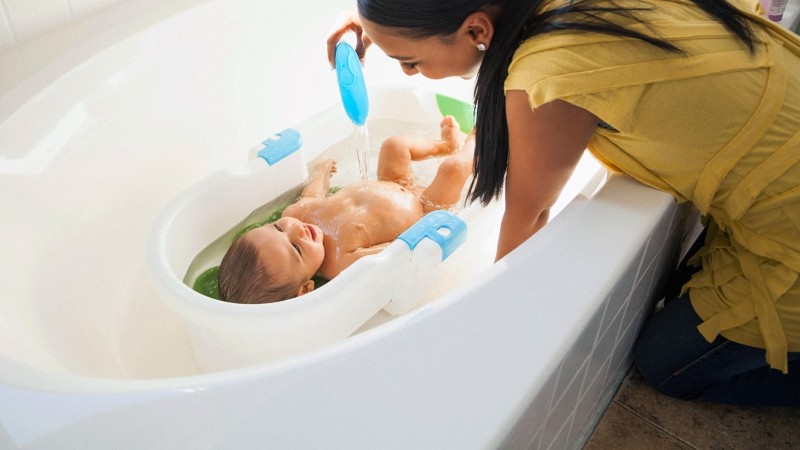
Bath time is an important time for you and your new baby, both for keeping them clean and for having a bonding moment between the two of you, with cuddles and songs! However, placing your baby right into a grown-up bathtub can be a little nerve-wracking, as your little ones could easily slip and hurt themselves. You can avoid this worry with a baby bath bucket!
But how do you choose the best baby bath bucket for you and your newborn? Read on to learn everything you need to know about baby baths, as well as some of the best options on the market today.
What Is A Baby Bath Bucket or Bathtubs?
Baby bath buckets, also known as baby bathtubs, are a smaller kind of tub that allows you to wash your baby without placing them into a larger adult bath tub. They can range from a standard plastic tub to a hammock shape that supports your newborn’s back, to inflatable or fold-up versions that are easily packed away when not being used.
Often, baby baths are made from foam or polyester materials that cradle your baby and prevent them from slipping around during the bath. Some baby bath buckets sit in the sink or an adult bathtub, while others stand alone. Baby bath buckets that fit in the sink may be the best option for you if you have a small living space without a bathtub. The most convenient baby bathtubs are ones that provide more than one possible support position for your baby, who might prefer to take their baths sitting up as they get bigger!
Of course, you may decide that you don’t need an extra designated bathtub for your baby. Plenty of parents simply sit in their own adult bathtub with their newborn on their lap and wash them that way. However, taking a bath with your baby is not always the most convenient option, especially since babies are known to suddenly poop at the most inopportune moments!
Keeping Your Baby Safe at Bath Time
Giving your newborn baby a bath for the first time can be an intimidating thing. Babies are small and vulnerable, and the last thing you want is to hurt them! Here are some tips for keeping your baby safe during a bath.
Supervise Children
First and foremost, always remember that when there is water present, you must supervise your baby at all times. An infant can drown in just an inch or two of water, and unlike in the movies, drowning can be a silent event. Always keep within reach and sight of your children at bath time! This means placing everything that you will need during a bath within reach of the tub, so you do not have to walk away to get it. These things include soap, towels, shampoo, and a fresh diaper and change of clothing for your baby. Never leave your baby alone in the bathroom!
Not Too Hot!
You also want to be sure that the bathwater is an appropriate temperature before placing your baby in the water. Your baby’s skin is a lot more sensitive than yours, so keep the water lukewarm! Test the water on your wrist, forearm, or elbow to make sure it is not too hot.
Beware of Spills
It is also a good idea to have plenty of towels or bathmats on hand to sop up spills. Whenever you have a baby splashing in the water, you are inevitably going to end up with water on the floor around the tub or sink! Clean up those spills right away so that you will not slip or fall, hurting yourself and potentially your baby as well.
Avoid Bath Rings
Safety experts strongly discourage using bath rings or bath seats, which orient your babysitting upright inside the adult bathtub. If your baby slips through the ring, they can become trapped underneath the water, and the result is even more hazardous than if they had simply been set into the full bathtub without any assistance.
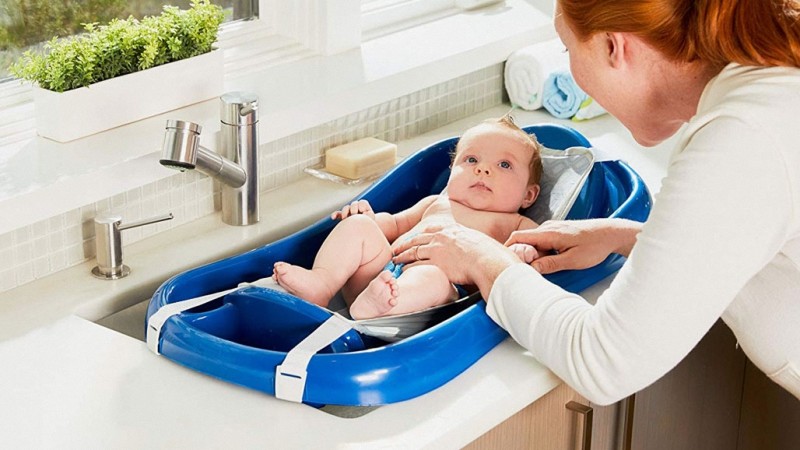
The Best Baby Bath Buckets
There are a lot of types of baby bath buckets to choose from. Here are some of the best ones out there!
The First Years Sure Comfort Bath Tub
This baby bath tub fits in the sink and has a mesh attachment which suspends the baby over the water just like a hammock.
Why we like it:
- Hammock attachment keeps newborn out of the water for safety
- Can remove mesh attachment as your baby grows and needs more of a bathmats
- Stable when setting in the sink, on the floor, on a counter, or in a bathtub
- Cubby area near the baby’s feet can store soap or toys for your baby
- Foot-stop keeps your baby from sliding down in the tub
You might want to choose this one if:
You are looking for a simple, safe, durable baby bath which you will be able to use throughout your child’s early life.
Blooming Bath Lotus Baby Bath Tub
This rigid plastic tub has an adorable lotus flower shape with a soft fabric interior, and is designed to be fit in the sink.
Why we like it:
- Soft interior is very comfortable for baby
- Overlapping petals support baby’s back and shift to fit in different sizes of sinks
- Fabric interior can be hung up to drip-dry or put in the dryer
You might want to choose this one if:
You plan to always wash your baby in the kitchen sink.
PRIMO EuroBath Baby Bath Tub
This plastic tub is much larger than most baby bath buckets, and is sturdy enough to last while your baby grows.
Why we like it:
- Larger tub will work for kids up to around three years old
- Works well on the floor, in the bath tub, and on a large counter
- Newborn area has contoured seat to safely secure your baby
You might want to choose this one if:
You don’t plan on washing in the sink, and want a simple bath tub which will allow room for your baby to grow!
Now you’re ready to keep your baby clean and safe!
Best Breast Milk Storage Bags of 2019
BY mariouda2108
0 COMMENTS
0 COMMENTS
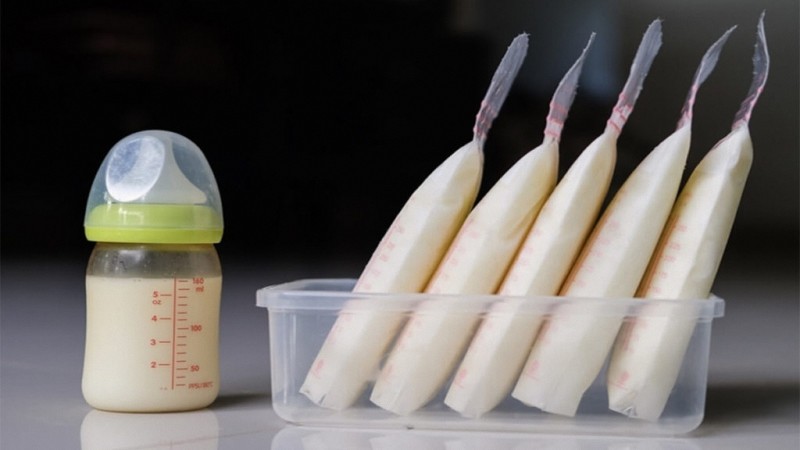
Best Breast Milk Storage Bags of 2019
As the old saying goes, there’s no use crying over spilled milk – but you won’t have to worry about spilling your breast milk with a breast milk storage bag! A good breast milk storage bag will keep the milk you pumped safe, secure, and sanitary until you are ready to feed your infant.
What Is A Breast Milk Storage Bag?
You might think that placing the liquid into a plastic bag is just asking for a leak to occur. Breast milk storage bags are different from normal freezer storage bags. These bags are specifically designed to hold breast milk. They are sterilized, free from toxins, and made for easy pouring and storage. Also, remember that in some parts of the world, it is common to stock any kind of milk instead of plastic containers! Milk storage bags can take a lot of punishment before they even begin to leak.
While breast milk storage bags are not reusable, because they are sterilized before you get them, they are very cheap to buy in bulk. Also, because they are disposable, you do not need to spend time cleaning the bags!
Breast milk can be stored at room temperature for between six and eight hours, up to twenty-four hours in an insulated cooler bag, up to five days in the refrigerator, and up to two weeks in the freezer compartment of a refrigerator. So finding the best container to store your breast milk in can be very important, to keep the milk safe for your baby and convenient for you to get and use!
The Benefits of Pumping Breast Milk
Most experts agree that breastfeeding is the best way to feed your baby. However, your lifestyle as a mom might keep you from being with your baby all the time and feeding them on demand. Pumping your breast milk is a simple, effective way to keep up a good milk supply for your baby, even when you cannot feed them all the time. Storing breast milk means that you are able to go back to work or leave your baby with family members or a baby sitter, and know that your baby will be fed well! Additionally, some babies just plain prefer drinking from a bottle than the breast, and you want to be sure that they get all the good nutrients from breast milk regardless. You can also donate your pumped breast milk to a milk bank! The human body produces around twenty-five to thirty-five ounces of milk in a twenty-four hour period when at peak milk production, so there is plenty of milk to go around.
It is important to plan your pumping sessions around you and your baby; all families are unique! If you are breastfeeding as well as pumping, pump in the morning to get the most milk out of the session and pump in between breastfeeding sessions as well. Breast milk production volumes tend to gradually decrease throughout the day and into the evening, though it’s important to remember that everyone’s breasts are different and you should consult with your doctor or another healthcare provider if you have any concerns or questions. If you are exclusively breast pumping instead of directly breastfeeding, you should pump between eight and ten times in a twenty-four hour period. All you need then is a quality electric breast pump and some breast milk storage bags!
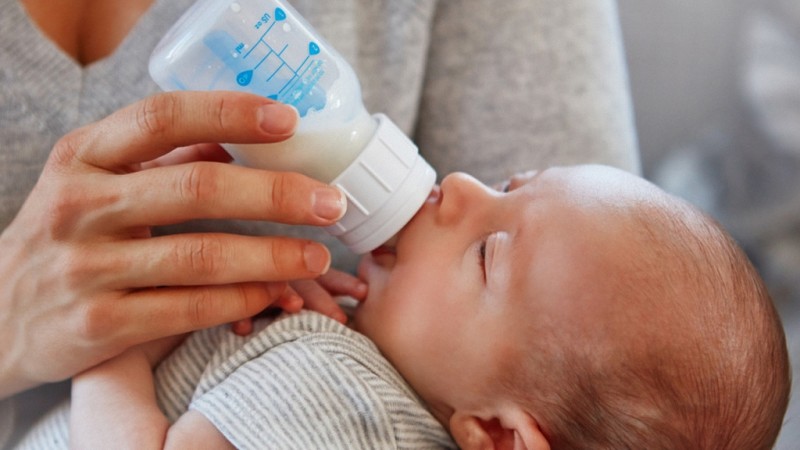
The Best Breast Milk Storage Bags
There are many different kinds of breast milk storage bags to be found on the market these days. Here are the best ones out there for you to consider!
Kiinde Twist Cap Breast Milk Bag
This breast milk storage bag, though pricey, fits neatly into a baby bottle for a simple transition between pumping and feeding.
Why we like it:
- holds up to six ounces of liquid
- fits almost any breast pump and the average size of a baby bottle
- reduces the need for washing, because no milk comes into contact with the baby bottle itself
- removes steps of transferring milk from storage bag to bottle and of cleaning baby bottle
- spout in bag results in easy pouring when necessary
- strong construction makes for a leak free design
You might want to choose this one if:
You want a bag that is sturdy and easy to use, you don’t want to clean your baby bottle all the time, and have the budget for a pricier breast milk storage bag.
Nuk Seal ‘N Go Milk Storage Bags
This breast milk storage bag has a secure double zipper opening to prevent leaks and spillage, and stand on their own on the counter.
Why we like it:
- free standing ability means you can use both hands to pour the milk, reducing spills
- double zipper opening locks the breast milk into the bag, preventing leakage while thawing
- designated space on the bag to write the date and time of pumping to keep track of spoilage
You might want to choose this one if:
You prioritize having a breast milk storage bag that can stand on its own.
Lansinoh Breast Milk Storage Bag
This relatively well-known brand has a competitive price and an easy to use spout.
Why we like it:
- the bags come in boxes of one hundred at a time
- spout design means less spilling while transferring milk from bag to bottle
- the lower price is great for a tighter budget
- holds up to six ounces of breast milk
You might want to choose this one if:
You have a smaller budget for breast milk storage bags.
Medela Pump and Save Breast Milk Bags
This breast milk bag comes with an adapter that connects it directly to the bottom of a Medela breast pump, saving time while pumping.
Why we like it:
- reduces the risk of spills while pumping
- thick base allows the bags to stand upright on their own
- holds up to five ounces of liquid
You might want to choose this one if:
You have a Medela breast pump and want to use its convenient adapter feature.
Now you’re ready to start pumping breast milk for your baby!
CBD Oil for Anxiety: How CBD Helps with Stress & Anxiety
BY mariouda2108
0 COMMENTS
0 COMMENTS

CBD Oil for Anxiety: How CBD Helps with Stress & Anxiety
If you are one of the thousands of people who suffer from anxiety, you may want to consider taking CBD oil as an over the counter remedy for your distress. CBD oil is an increasingly popular solution for a wide host of negative physical and mental conditions, including anxiety, stress, and depression. But just what is CBD oil? What are its effects? And how do you take it for maximum positive effect? To learn everything that you need to know about CBD oil and how it can help alleviate your anxiety, read on!
What Is CBD Oil?
Also called “cannabidiol,” CBD is one of the compounds that you can extract from cannabis plants, including marijuana and hemp. CBD oil is becoming increasingly popular as a treatment for all kinds of ailments, because it has been found to create many benefits, both psychological and physical! Like tetrahydrocannabinol or THC, another compound found in cannabis plants, CBD attaches to the receptors in the human brain that control both your mood and your sensitivity to pain. Unlike THC, however, CBD does not make you feel like you are euphoric or “high,” because it is not a psychoactive compound.
In 2018, the United States government fully legalized industrial hemp, opening the doors for CBD oil made from hemp to become a home remedy for anxiety all across the nation. However, the connotation between CBD and marijuana may lead you to be a bit wary of using it for health benefits.
What Is Anxiety?
Anxiety comes in many kinds and levels of seriousness, including social anxiety, panic disorder, generalized anxiety disorder, post-traumatic stress disorder, insomnia, and many different phobias. In general, anxiety involves a heightened amount of restlessness, stress, and worry, preventing you from being able to make decisions or confront difficult situations in your daily life.
It is important to talk with your doctor or another health care provider before deciding how to treat your anxiety. Some versions of anxiety can be handled through therapy, or without medicinal supplements at all. Other people with anxiety will find that CBD oil is the best solution for them. You want to find the solution that is best for you!

CBD Effects on Anxiety
People with anxiety have been using cannabis to alleviate their symptoms since the 1500s. When it affects the receptors in your brain, the CBD in cannabis plants alters your serotonin levels, inducing a more relaxed mood that can combat anxiety, depression, and stress, without creating the euphoric “high” that THC does. Cannabidiol has also been found in clinical studies to reduce social anxiety, alleviate insomnia, and also lower blood pressure. CBD oil is also appealing to many people with anxiety because it lacks the unpleasant side effects notoriously found to accompany many psychiatric medications, and it is also not addictive like weed or other marijuana products are.
The FDA approves CBD as an over the counter supplement, but it does not support companies which market this oil as an absolutely confirmed cure for any severe mental or physical medical condition. Consequently, there is no FDA approved dosage for CBD. While there is no need to worry about psychoactive effects from high doses of CBD oil, if you experience dizziness or nausea from a dose of cannabidiol, you may want to lower the dose.
How to Take CBD Oil
There are multiple methods for taking CBD oil. Read on to learn about four methods, so that you can pick the one that will best fit your lifestyle and preferences.
Ingested Orally
Most people who take CBD oil to help with their anxiety decide to take the oil by ingesting it orally. CBD oil comes in many edible forms, including foods, beverages, and capsules. You can also add the oil to your favorite food or drink yourself. If taking CBD oil in the form of a capsule, you should wash down the capsule with a small gulp of water, just like you would with another non-chewable vitamin. After you ingest the CBD oil product, the oil will be processed by your digestive system and sent to the liver, which will gradually metabolize the active CBD compounds. From there the CBD compounds will enter your bloodstream and create their calming, stress-reducing effects.
Administered Sublingually
CBD oil also comes in the form of tinctures and concentrates, which you can take in a sublingual method for maximum efficiency. “Sublingual” is a term that refers to the act of holding a substance under your tongue. When you hold a CBD oil tincture under your tongue for over a minute, the mucus membranes in your mouth have the chance to directly absorb the active CBD compounds. This sends the CBD to your bloodstream right away, without having to wait for the digestive system and liver to process the capsule. Though some people do not like holding something under their tongue for that long, the result is a much quicker sensation of relief of anxiety than ingesting a capsule.
Applied Topically
Some people with anxiety prefer to take CBD oil in the form of a salve or lotion, which you are able to apply directly onto your skin. However, this method may not be as effective as the other methods for reducing anxiety. When applied topically, the CBD oil’s active compounds are only absorbed by the nearby skin cells on your body, and the CBD never actually enters your bloodstream or reaches your brain. This makes CBD oil lotions a good choice for people taking CBD oil for acne or inflammation, and less so for anxiety.
Inhaled
Vaping is an increasingly popular activity for smokers and non-smokers alike, and it is possible to use CBD oil in a vape. As the vape heats up the CBD oil, the oil releases its active compounds, which then diffuse right from your lungs into your bloodstream. Like sublingual tinctures, vaping is an efficient way to get quick results from CBD oil for calming your anxiety.
Now you’re ready to consider using CBD oil to treat your anxiety!
CBD Oil for Kids: Is It Safe and What Parents Should Know
BY mariouda2108
0 COMMENTS
0 COMMENTS
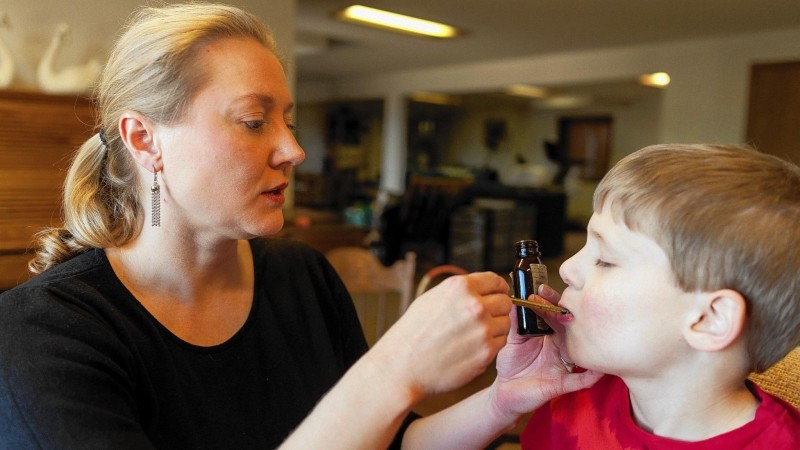
CBD Oil for Kids: Is It Safe and What Parents Should Know
If you are a parent, then keeping your child healthy is top on your list of priorities. You may have heard that some other parents are using CBD oil, a product of cannabis plants, to treat their children’s ailments. But exactly what is CBD oil? What are its effects? And is it safe for you to give CBD oil to your children? Read on to learn everything you need to know about CBD oil.
What Is CBD Oil?
CBD oil, which is short for “cannabidiol,” is a relative newcomer to the world of healthcare. CBD is the main non-psychoactive component of the marijuana plant. It is not the same thing as THC or tetrahydrocannabinol, the compound found in marijuana that you are more likely to have heard of before, which is the one that creates a “high.” CBD is becoming increasingly well-known these days and is growing in popularity as a way to stave off a wide range of negative health symptoms, including inflammation and anxiety. Today, hundreds of online companies sell CBD in a variety of products, including edibles, beverages, vaping liquid, sprays, tinctures, capsules, hand lotions, shampoos, and gels. Some parents are even deciding to give CBD oil products to their children, hoping for positive effects.
Is CBD Oil Dangerous for Children?
Unlike THC, CBD does not “get you high.” Despite its chemical similarities to THC and products containing THC, CBD oil is non-psychoactive. It does not bind with the cannabinoid receptors in your brain. CBD can also be extracted from the hemp plant, another member of the cannabis plant family that contains next to no THC at all. So if you are worried about getting your child addicted to the marijuana “high” through CBD oil, that is not a consequence of ingesting CBD oil products. While it is illegal to get a child intoxicated, and products containing THC can only be purchased in certain states by adults aged twenty-one years and older, CBD is not illegal for minors to purchase or ingest.
Also, cannabinoids and endocannabinoids – the categories that CBD belongs to – occur naturally in the human body, and children are exposed to them all the time. As a matter of fact, human breast milk is a source of vital endocannabinoids that help your infant develop. However, the association between CBD and THC, given that they come from the same plant family, means that many people are wary of taking CBD oil products at all, let alone giving them to their children.
Of course, it is always a good idea for you to speak with your child’s doctor before you decide to give them any supplement, including CBD oil products. You want to be sure that you know all of your options so that you can have the best possible outcome for your child! You should also be sure to double-check the contents of the oil you purchase if you get it from a legal medical marijuana store – the products from those stores often contain some amount of THC!
CBD Effects for Kids
CBD has been found by those who have taken it to have a large number of notable health benefits, many of which could improve your child’s life. CBD alleviates the symptoms of some serious medical conditions, including drug-resistant forms of epilepsy. In some cases, patients who took CBD oil products have reached complete remission from their seizures! CBD oil products are also used to alleviate chronic pain, acne, and arthritis in people of all ages.
Additionally, though CBD is not a psychoactive compound, people who have taken it report that they felt both physically and mentally more relaxed as a result. This indicates that CBD could be an appropriate treatment for anxiety in children, as well as other negative mental health conditions, including sensory processing, ADHD, depression, insomnia, and autism. While you might be concerned as a parent about giving your child too many pharmaceutical drugs to help them focus in class, CBD is a natural alternative to other products.
If your state has not yet legalized marijuana, you may need a doctor’s prescription in order to purchase CBD oil products. Otherwise, it should be available as an over the counter purchase.
How Kids Can Take CBD Oil
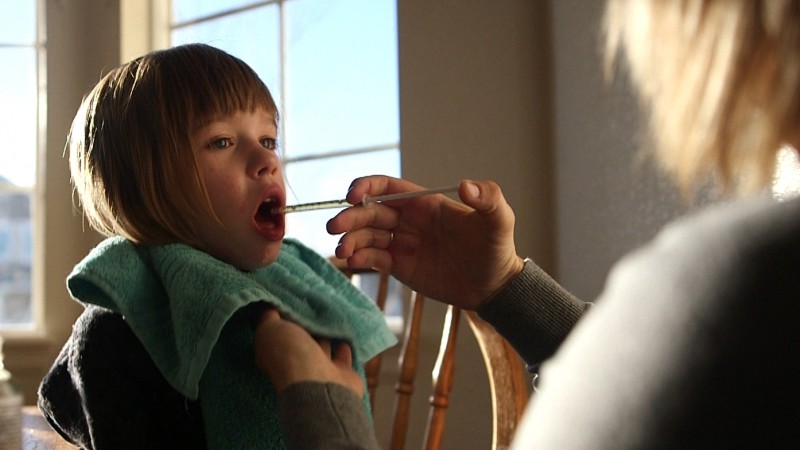
There are multiple ways for you to give CBD oil to your child. Take a look at the methods below, and decide which one is the best for you and your kids!
Ingest it in Capsule Form
The most common and easiest way to take CBD oil is to ingest it in the form of a tincture or a pill. The benefit of this method is that it maintains the impression that this is a medicine, not a snack, so your child will understand that it should only be eaten at certain times.
Other Edibles and Beverages
Of course, many children are not a fan of taking their medicine. Fortunately, there are other, much tastier and more appealing forms of CBD oil, in the shape of treats such as gummy bears, chocolates, and cake pops. The tricky thing about these sweeter forms of CBD oil is that they may tempt your child to eat too many – and as the old saying goes, too much of a good thing can be bad for you!
Topical Application
CBD oil can also come in the form of lotions and sprays, which are excellent for applying the oil to a specific part of the cells on your body. For example, if your child is suffering from acne on a certain part of their face or inflammation in their hands but not elsewhere on their body, then applying CBD oil lotion directly to the affected area will focus the curative properties only on the area in which it is needed. Applying a lotion may also be easier than getting your child to swallow a pill!
Now that you know about the effects of CBD, you are prepared to take charge of your child’s health in this new way!
Best Baby Bassinet You Can Buy in 2019
BY mariouda2108
0 COMMENTS
0 COMMENTS
Best Baby Bassinet You Can Buy in 2019
If you are a new parent trying to find the best place for your baby to sleep in, you should consider a bassinet. Read on to learn everything you need to know about this comfortable alternative to a crib!
What Is A Bassinet?
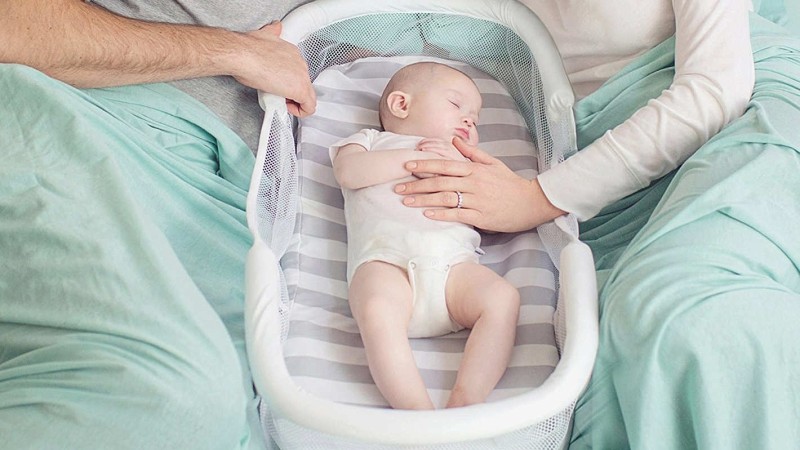
A bassinet is a bed for a newborn baby, usually shaped like a basket and set in a fixed frame. Some bassinets are designed to be able to swing freely, to rock a baby for comfort; this specific kind of bassinet is also known as a cradle. Many bassinets have a cover or a hood that you can pull over to shield your baby from light and noise while they are asleep. Bassinets are also portable, meaning that you can move it around the house instead of keeping it in one room, so you never have to be too far away from your napping baby.
What’s the Difference Between a Bassinet and a Crib?
Bassinets and cribs are both places where newborn babies can sleep. However, there are a few key differences between bassinets and cribs, and they each have their pros and their cons.
Size Difference
Cribs are much larger than bassinets, taking up a lot more space in a room. As a result, bassinets are a lot easier to fit into a smaller house or room. It can also be easier to lean over the railing and place the baby inside of the bassinet, because of its smaller size and lower sides, which is very useful if you are still sore and tired from a difficult birth process. Many bassinets are portable because of their small size and light weight.
Differences in Durability
Bassinets are usually very lightweight and also only built to hold a certain amount of weight, the average weight of a baby in their first few months of life. On the other hand, cribs can hold much more weight and are much sturdier, and consequently can be used into early childhood.
Price Differences
Usually cribs are more expensive than bassinets. While this can be good for a long-term investment, new parents on a budget may prefer a bassinet until they have saved up enough for a toddler bed.
Safety Standards for Bassinets
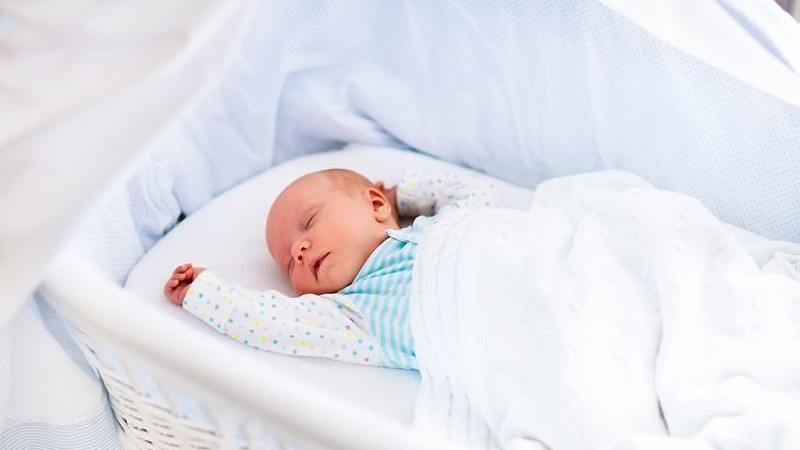
No matter what kind of bassinet you get, and no matter whether you bought it new or used, you should always check the conditions of your baby’s bed before you put your baby into it. The mattress of the bassinet should be flat, firm, and bare. Avoid using sleep positioners or other kinds of extra padding, to avoid suffocation; though they may seem comfy, they can prove dangerous for your baby. Never place the bassinet near a hanging cord or a drape, because those can be strangulation hazards. Always place your newborn baby to sleep on their back!
The Best Bassinets for Newborns
There are a lot of bassinets on the market to choose from. Here are some of the best ones out there!
HALO Bassinest Swivel Sleeper Bassinet
This bassinet is a bit pricey – but that’s because it has so many features!
Why we like it:
- the base can be adjusted to fit any bed height for easy reach during the night
- nightlight, sleep sounds, and soothing vibrations for better sleep
- can rotate and swivel to help you reach your baby-pro
- sturdy feeling even at the top height
You might want to choose this one if:
You have a wider budget for baby furniture, you want your baby to stay within reach of your bed while you sleep, and you want to give your newborn baby the works!
BabyBjorn Gentle Rocking Cradle
This sleek, stylish bassinet is simple and natural, perfect to be set next to a shorter bed.
Why we like it:
- beautiful appearance makes it a great addition to any room
- lightweight suspension system lets it rock itself in response to your baby’s movements, without a noisy motor
- slides right underneath an average height adult bed smoothly
- breathable mesh allows you to see your baby through the wall of the bassinet
You might want to choose this one if:
You want a simple, natural bed for your newborn without too many fancy features.
Chicco Lullago Portable Bassinet Travel Crib
This bassinet is designed for a life on the go, with a lightweight design, simple set-up method, and a comfortable interior.
Why we like it:
- lightweight and easy to take with you when you are traveling
- comes with a bag you can sling over your shoulder or pack in the trunk of your car
- lightweight and high-quality materials can be removed from the frame for machine washing
- same size and comfort level as pricier bassinets, for a lower price
You might want to choose this one if:
You anticipate traveling a lot while your child is still young, and want to make sure that you have a comfy, familiar bed available for your baby wherever you go.
Graco Dream Suite Bassinet
This bargain-priced bassinet conveniently doubles as a changing table.
Why we like it:
- costs less than other bassinets, without sacrificing quality
- pull a handle and flip it over to transform it into a changing table – more convenient than attempting to change your baby’s diaper in the bassinet itself!
- sturdy build with a handy storage area under the basket
- locking wheels allow for mobility
- soothing vibration settings to help your baby sleep
You might want to choose this one if:
You want to save on baby furniture by getting two important objects in one – a place to sleep and a place to change diapers!
Fisher-Price Soothing Motions Bassinet
This bassinet is full of exciting features, allowing it to rival more expensive baby beds.
Why we like it:
- the ideal height to sit beside the average bed
- the basket rocks with a natural movement triggered by your baby’s motions, but it does not tilt the sleeping surface when it does so, keeping your baby stable and safe
- adorable hanging stars mobile, soothing nightlights and vibrations to help comfort your baby and lull them to sleep
You might want to choose this one if:
You are a new parent on a budget who still wants your baby to sleep in maximum comfort.
Now you’re ready to choose the bassinet that is perfect for you and your baby!


